Robotics Institute Germany
The Robotics Institute Germany (RIG) is an initiative that the Federal Ministry of Research, Technologie and Space (BMFTR) has been funding with 20 Million euros over four years since 2024. The RIG comprises 14 German universities and research institutions. There are also 19 associated partners. The aim is to connect leading robotics locations in Germany, increase international visibility, attract talent, and accelerate progress in AI-powered robotics. We are developing responsible and innovative robotics and AI for the benefit of society and the environment, thereby providing important impetus for the economy. RIG is driven by the shared vision of positioning Germany as a global leader in embodied AI and robotics. By fostering a vibrant ecosystem, we enable cutting-edge research, cultivate world-class talent and ensure that innovation translates into real-world solutions. Together we are shaping a sustainable and innovative future that benefits society and drives economic growth. Link to project: https://robotics-institute-germany.de/
Partners:
- Federal Ministry of Education and Research
- Technical University of Munich
- TUM University Hospital
- Karlsruhe Institute of Technology
- University of Bonn
- University of Technology Nuremberg
- Technical University of Berlin
- Dresden University of Technology
- University of Bremen
- RWTH Aachen
- Technical University of Darmstadt
- University of Stuttgart
- German Aerospace Center
- German Research Center for Artificial Intelligence
- Max-Plank Institute for Intelligent Systems
- Fraunhofer Institute
Associate Partners
- University of Lübeck
- University of Hamburg
- Leibniz University of Hannover
- Technical University of Braunschweig
- Bielefeld University
- German Rescue Robotics Center e. V.
- Ilmenau University of Technology
- Chemnitz University of Technology
- University of Bayreuth
- Friedrich-Alexander-University of Erlangen-Nuremberg
- Hessian Center for Artificial Intelligence
- University of Kaiserslautern-Landau
- Heidelberg University
- Cyber Valley GmbH
- University of Augsburg
- Fraunhofer Institute
- University of Tübingen
- University of Freiburg
- Baiosphere
- Ludwigs-Maximilians University of Munich
- University of Konstanz
We are developing responsible and innovative robotics and AI for the benefit of society and the environment, thereby providing important impetus for the economy. RIG is driven by the shared vision of positioning Germany as a global leader in embodied AI and robotics. By fostering a vibrant ecosystem, we enable cutting-edge research, cultivate world-class talent and ensure that innovation translates into real-world solutions. Together we are shaping a sustainable and innovative future that benefits society and drives economic growth.
Publications
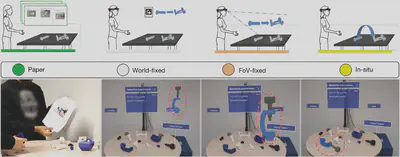
Springer VR (Journal) We are happy to highlight our Springer Virtual Reality journal article on the evaluation of AR guidance techniques by Julian Kreimeier, Prathik Prasad, Shiyu Li, Niklas Corell, Luisa Theelke, Constantin Kleinbeck, Hannah Schieber, Simon Weidert, Sebastian Andress, Felix Merkl, Alejandro Martin-Gomez and Daniel Roth.Evaluation of Visual Guidance Techniques for Augmented Reality-Supported Assembly Tasks in the Medical Context @Springer VR Journal 2026
MICCAI 2026
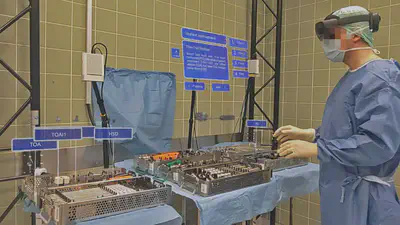
Multi-Camera AR Guidance System for Surgical Instrument Handling and Assembly @MICCAI Conference 2026
We are happy to present our MICCAI paper on by multi-camera augmented reality guidance by Shiyu Li, Julian Kreimeier, Hannah Schieber, Dirk Müller, Bernhard Kainz, Rüdiger von Eisenhart-Rothe and Daniel Roth at MICCAI 2026 in Straßbourg.
IEEE ICRA 2026 - SRRA Workshop IEEE ICRA SRRA workshop “LiftNav: Path Planning via Semantic Lifting in TSDF-Guided Gaussian Splatting” authored by Hannah Schieber, Dominik Frischmann, Victor Schaack, Angela P. Schoellig, and Daniel RothLiftNav: Path Planning via Semantic Lifting in TSDF-Guided Gaussian Splatting @ICRA SRRA Workshop 2026
IEEE RA-L 2026 We are happy to announce that SplatXtract was accepted in IEEE RA-L. The work is authored by Hannah Schieber, Constantin Kleinbeck, Angela P. Schoellig, Stefan Leutenegger and Daniel RothSplatXtRact: Tractable Gaussian Splatting via Open World Region-of-Interest Extraction and Refinement @ IEEE RA-L