Abstract
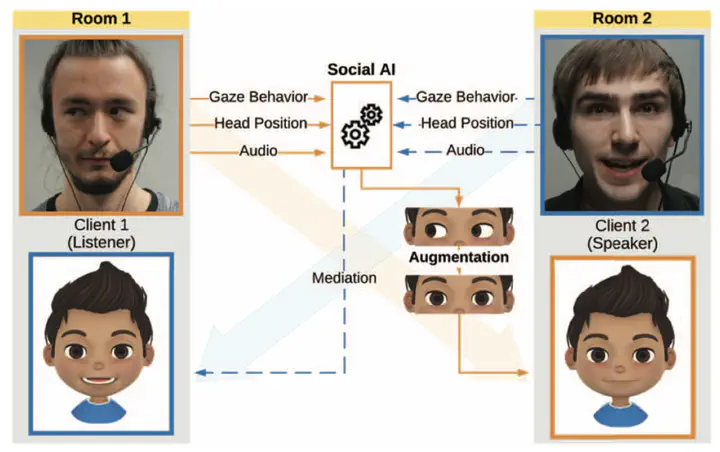
Human gaze is a crucial element in social interactions and therefore an important topic for social Augmented, Mixed, and Virtual Reality (AR, MR, VR) applications. In this paper we systematically compare four modes of gaze transmission: (1) natural gaze, (2) hybrid gaze, which combines natural gaze transmission with a social gaze model, (3) synthesized gaze, which combines a random gaze transmission with a social gaze model, and (4) purely random gaze. Investigating dyadic interactions, results show a linear trend for the perception of virtual rapport, trust, and interpersonal attraction, suggesting that these measures increase with higher naturalness and social adequateness of the transmission mode. We further investigated the perception of realism as well as the resulting gaze behavior of the avatars and the human participants. We discuss these results and their implications.