From Virtual Actions to Real-World Impact: Exploring the Normative Effects of Reality Simulation for Climate Change
Abstract
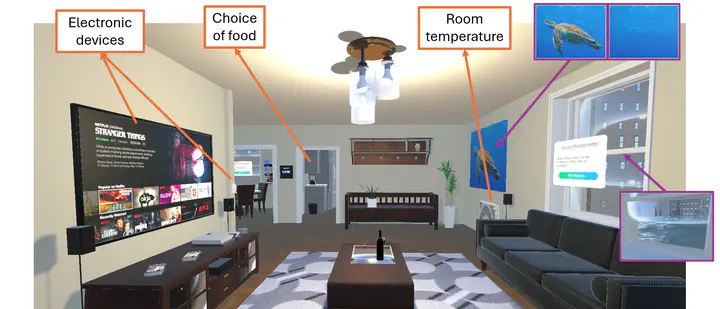
The consequences of climate change become increasingly severe. More individual education and action are needed to counteract these effects. Virtual reality (VR) may help overcome limitations of traditional education by immersing users in virtual environments and allowing them to experience the consequences of their actions. To explore how VR can activate changes in sustainable behavior (as postulated by norm activation theory), we employ a gameful immersive VR simulation of everyday behavior impacts. Using a randomized pretest-posttest design, we measured awareness of consequences, ascription of responsibility, personal norm, and sustainable behavioral intention before and immediately after the VR simulation and the text- and video-based control intervention. Our mixed-methods experiment (n=51) shows that both traditional media (control condition) and VR (experimental condition) can achieve short-term effects. While VR did not significantly outperform the control condition, qualitative insights highlighted VR’s capacity to elicit strong emotional responses. Our insights suggest that immersive exposure may add affective salience to responsibility-related experiences and call for further research on VR’s role in translating intentions into effective behaviors.

Julian Kreimeier
Senior Researcher,
Research Manager
I research human-computer interaction, accesibility and extended reality.