Gaze-Based Augmented Reality Selection on the Magic Leap 2: Comparing Eye-Only and Foot-Pedal Confirmation for Scrub Nurses and Laypersons
Abstract
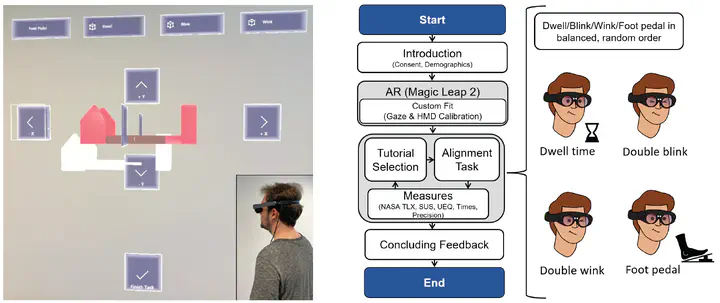
In hands-busy settings such as surgical and industrial work, augmented reality guidance can support task execution but requires reliable hands-free input. Prior work has explored multiple modalities, yet direct comparisons of eye-only selection against an established baseline remain limited, especially when considering differences between domain professionals and laypersons. We compared three confirmation mechanisms for gaze-based pointing on a Magic Leap 2: Dwell time, double blinking, and double winking against a foot-pedal baseline in a within-subject study with 32 participants (16 scrub nurses and 16 laypersons). The foot pedal achieved the best usability and user experience ratings. Double winking yielded faster normalized per-selection performance than dwell time and the foot pedal, but did not reduce total task completion time or improve subjective ratings. Across measures, scrub nurses and laypersons differed mainly in subjective assessments, while objective timing measures showed no significant between-group effects. Our results provide a device- and parameter-specific benchmark for gaze-based pointing with eye-only and foot-pedal confirmation in constrained environments.

Julian Kreimeier
Senior Researcher,
Research Manager
I research human-computer interaction, accesibility and extended reality.