The Influence of Environmental Fidelity on Virtual Presence, Intrinsic Motivation, Cognitive Load and Learning Outcomes in Medical VR
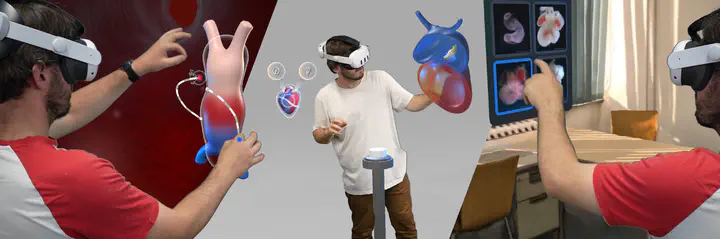 Teaser
Abstract
Immersive virtual reality learning environments (IVRLEs) are increasingly used in medical education, yet the role of environmental fidelity—particularly scene design—remains underexplored. This study examines how varying levels of fidelity and contextualization affect motivational and cognitive outcomes. Eighty-seven medical students were randomly assigned to one of three scene conditions: a minimalistic “Blank Scene,” a “Reconstructed Classroom Scene”, or an “Inside-Human Scene”. All students used a custom-developed application to learn about embryonic heart development. We measured virtual presence, intrinsic motivation, cognitive load, learning outcomes, and usability. Results showed that scene design influenced virtual presence, selected aspects of intrinsic motivation, cognitive load, and learning outcomes. The Inside-Human Scene elicited higher physical and self-presence as well as higher comprehension scores compared to the Reconstructed Classroom Scene. The Reconstructed Classroom Scene was associated with higher extraneous cognitive load. Intrinsic cognitive load was rated higher in the Inside-Human Scene, while germane cognitive load did not differ between conditions. No significant differences were found for task performance or factual recall. Overall, the findings indicate that scene design in IVRLEs affects how learners engage with complex content and may support deeper understanding when perceptual and contextual properties are coherent, while visually detailed environments may increase extraneous cognitive demands without improving learning.

Constantin Kleinbeck
Doctoral Candidate
My research interests include Virtual and Augmented Reality, 3D Rendering, Interactivity and AI.