Evaluating Cutout Rendering Techniques for Pass-Through Embodiment Using a Real-Mirror Metaphor
Abstract
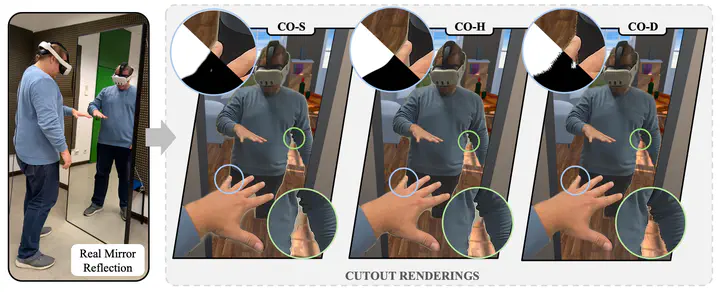
A convincing sense of embodiment in virtual reality (VR) is crucial for creating immersive and engaging experiences, as it shapes how users perceive and interact with their virtual bodies. The sense of embodiment is thereby, among others, affected by the shape, appearance, and fidelity of the virtual body. However, achieving convincing avatar appearance remains a challenge for VR applications. One promising solution is Pass-Through Embodiment (PTE), which enables users to see their real bodies in VR. PTE combines depth-based segmentation with the pass-through video stream of video-see-through displays to effectively visualize photon-captured representations of their own bodies. Despite the source-fidelity of the representation, the resolution of integrated depth sensors in Head Mounted Displays (HMD) can produce artifacts at segmentation boundaries, leading to visible aliasing. The perceptual impact of these artifacts on the VR experience remains unexplored. Therefore, in this paper we compare three edge-rendering techniques designed to reduce artifacts without compromising performance. Aside from a soft gradient, we introduce two new methods with a hard and dithered edge. The latter aims to balance the sharpness of hard masks with the smoothness of gradient transitions, without relying on alpha blending. To evaluate those methods in a PTE context, we conducted a within-subjects study that introduces a novel real-mirror paradigm, using an actual physical mirror as reference for reflection. We found significant results in measured presence and embodiment. Subsequent analysis revealed that our dithered cutout approach significantly outperforms hard masks, while no significant difference was found between soft condition. These results suggest a perceptual continuum where dithering and soft blending both effectively reduce visual artifacts through gradient representation. Together with high overall ratings on presence and embodiment across all conditions, these findings confirm PTE as a robust method for supporting embodiment and presence, while highlighting the potential of dithering as a computationally efficient yet perceptually comparable alternative to smooth blending.

Kristoffer Waldow
Doctoral Candidate
Kristoffer is a Doctoral candidate at the Technical University of Munich, Human-Centered Computing and Extended Reality Lab and a research associate at the TH Köln, Computer Graphics research group. His field of interest is Mixed Reality (MR) technologies, especially human-computer interaction in MR environments to improve interpersonal communication and accessibility with avatars.